Buying guide
Questions to Ask a Cabinet Maker Before You Hire One
The questions to ask a cabinet maker are less about the shop and more about your project: what gets built, from what, who measures, who installs, and what the written quote actually covers. Ask the eight below at the first meeting, listen for a specific answer rather than a reassuring one, and you will know within an hour whether the conversation is worth continuing.
Why the questions matter more than the showroom
Every cabinet maker can show you a beautiful kitchen. What a photograph cannot show is whether the shop will build your room well: a house with walls that wander out of plumb, a ceiling that is lower on one side, an appliance you have already bought. The first meeting is where you find that out, and the way to find it out is to ask questions that have specific answers.
A good maker welcomes this. The questions below are the same ones a careful shop asks itself before quoting, so a clear reply is a sign you are talking to someone who has already thought the job through. A reply that drifts into reassurance is a sign that they have not.
If you are still deciding between stock, semi-custom, and fully custom work, read the cabinet types guide first. These questions assume you have decided a built-to-measure job is worth pricing.
Questions about measuring and design
1. Who measures the room, and when? The person who measures should be the person, or the shop, that builds. Measurements passed along from someone else’s sketch are where most fit problems start. Ask whether the measure happens in your home and whether it covers the things that bite later: walls out of square, a floor that slopes, a window that sits off center.
2. Will I approve drawings before anything is built? You want a plan of the room and an elevation of every wall, showing door swings, drawer stacks, filler strips, and the openings for each appliance. Ask how many rounds of revisions are normal and what happens if you change your mind after approval. The answer to that last question tells you how changes will be priced later, which is worth knowing now.
3. How do you handle a room that is not square? Older Peninsula houses rarely are. A specific answer mentions scribing panels to the wall, adjusting fillers, or leveling the base run before the uppers go on. A vague answer, or a promise that it will not be a problem, should send you back to question one.
Our page on how a custom kitchen comes together walks through the design side in more detail, and the project process shows where approval fits in the overall sequence.
Questions about materials and construction
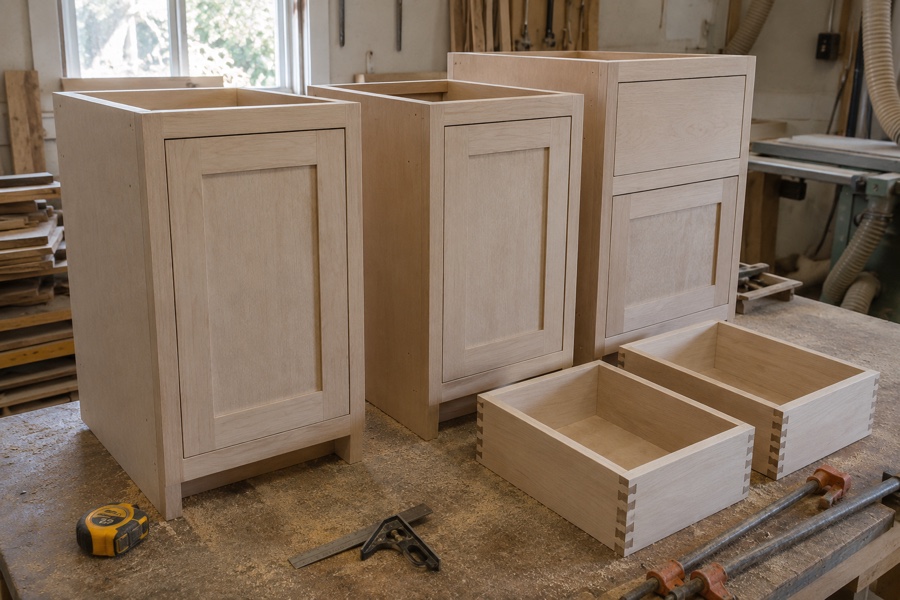
4. What are the boxes, doors, and drawers made of? Ask about the cabinet box material, the door and face material, and how the drawer boxes are joined. You do not need to become an expert. You need an answer you can write down and compare against the next shop’s answer. If two quotes differ a lot in price, the difference usually lives here.
5. What hardware goes in, and what finish goes on? Hinges and drawer slides are the parts you touch every day, and they are where a cabinet either keeps closing quietly or starts to sag. Ask what is specified and whether soft-close is included or an upgrade. For finish, ask whether it is painted, stained, or a factory surface, and how it is applied. Our materials and finishes page explains the common options in plain language, so you can follow the conversation.
Questions about the quote, the schedule, and installation
6. What does the written quote include, and what does it leave out? This is the single most useful question on the list. Ask whether the quote covers design, the cabinets themselves, the finish, the hardware, delivery, installation, and removal of the old cabinets. Then ask what is not in it: countertops, plumbing, electrical, painting walls, and patching drywall are often someone else’s job. A quote that answers this on paper protects both of you.
7. Who installs, and who is in charge on site? Some shops install their own work and some hand it to a separate crew. Either can work well. What matters is that one named person is responsible when a door needs adjusting or a panel arrives scratched, and that you know who that person is before installation day.
8. How long will it take, and what decides the timeline? Rather than accepting a single number, ask what the schedule depends on: drawing approval, finish selection, shop workload, and how ready the room is. A maker who explains the dependencies is giving you something you can plan a remodel around. For a stage by stage picture, see what a cabinet project looks like from start to finish.
Answers that should make you keep looking
Most of the warning signs are a missing answer rather than a wrong one.
- The quote is a single number with no description of what it covers.
- Nobody can tell you what the cabinet boxes are made of.
- Measuring is left to you, or to a contractor who will not be building the cabinets.
- There is no drawing to approve, only a verbal description.
- Changes after approval are described as “no problem” without saying how they are priced.
- You cannot find out who will be in your house on installation day.
None of these means the shop does bad work. Each one means a decision that should be made before you sign is being left until after, when it is more expensive to make.
How to compare two cabinet quotes fairly
Prices only mean something when the scope underneath them matches. Before you compare, line the quotes up against the same checklist: rooms covered, number of cabinets, door style, box material, finish, hardware, installation, and removal of the old work. Wherever one quote is silent, ask that shop directly rather than assuming it is included.
Once the scope matches, the comparison becomes honest. If you want a sense of what drives the number up or down before you start collecting quotes, our guide to what custom cabinetry costs breaks it down by the choices that move it most.
Asking these questions of us
We would rather you ask all eight. The first step with us costs nothing: someone comes to the house, looks at the room with you, and you get a written quote afterward, with no pressure and no obligation. Our patch runs from Millbrae and Burlingame down the Peninsula as far as Redwood City; the town-by-town hub covers each one. Bring this list, and hold us to it.
Frequently Asked Questions
What should I ask a cabinet maker at the first meeting?
Ask who measures the room, what the boxes and doors are made of, what the written quote includes and leaves out, who installs, and how changes are handled once drawings are approved. Those five answers tell you more than a portfolio does, because they describe the job you are actually buying rather than a job someone else bought.
Should I get more than one cabinet quote?
Yes, as long as each shop is quoting the same scope. Hand every maker the same list: which rooms, which cabinets, the door style, the finish, and whether installation is included. Two quotes built on different assumptions cannot be compared, and the cheaper one is often cheaper because it quietly leaves something out.
What is a red flag when talking to a cabinet maker?
Vague replies to concrete questions. A shop that cannot name its box material, cannot say which crew does the install, or shrugs at the idea of an out-of-square wall is telling you those decisions have not been made yet, and decisions made late are the expensive ones.
Do I need drawings before cabinets are built?
You should approve drawings before anything is cut. A plan view and elevations of each wall let you check door swings, drawer clearances, and appliance openings on paper, where a correction costs an eraser instead of a remade cabinet.
Want those questions answered for your own project?
Free in-home consultation and a written quote. No pressure, no obligation.