Reference
Materials and Finishes We Build With in San Mateo
This is the specification sheet behind every drawing we hand over: the sheet goods a carcass is cut from, the timbers kept on the rack, how drawer boxes are joined, what separates one grade of motion hardware from the next, and the coatings over all of it. Read it before comparing quotes.
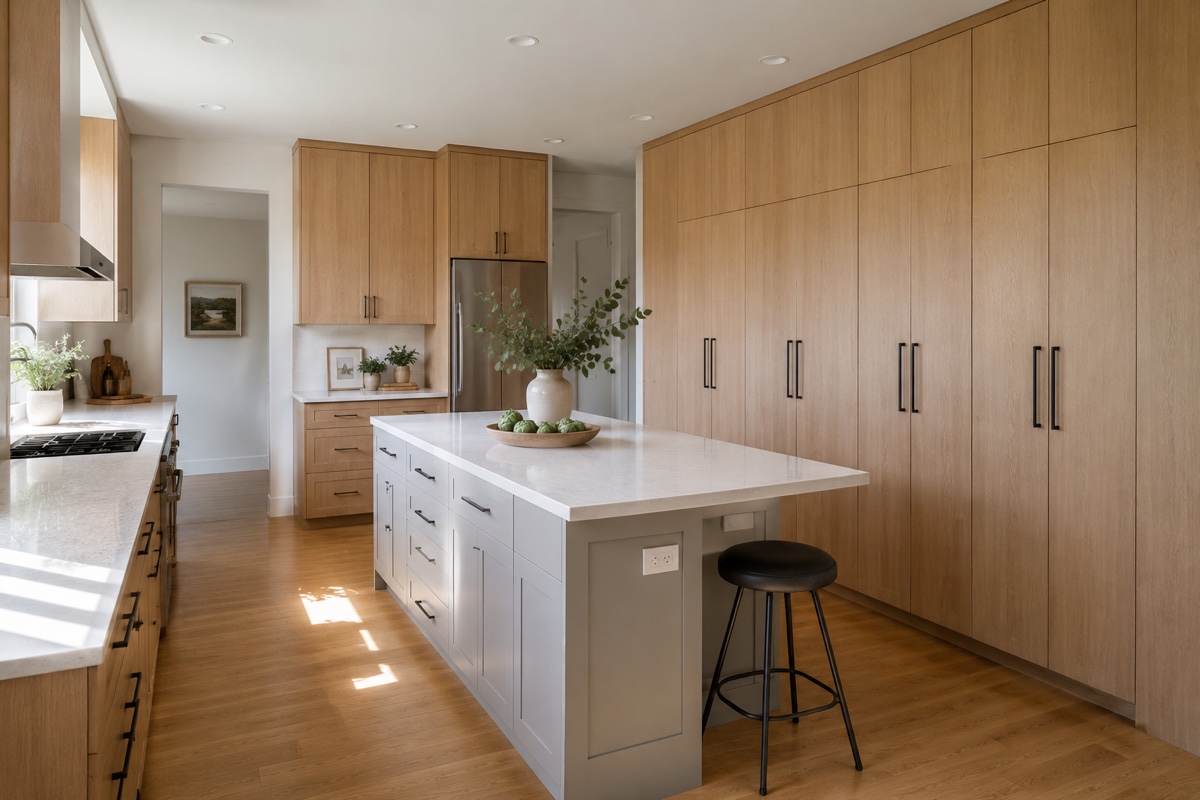
Sheet Goods: Why San Mateo Cabinet Boxes Start as Plywood
A carcass is sheet material and little else, so the sheet decides how the storage behaves for thirty years. Three cores are sold to shops like ours, and they are different products, not three prices for one.
Veneer core stacks thin layers with the grain of each turned across the layer beneath. That crossing is the whole trick: it keeps the sheet from expanding along one axis, and a screw biting into a cabinet side passes through several opposing layers instead of one. We specify three-quarter-inch stock, nine plies or better. Void-free counts for more than ply count, because an internal gap always seems to sit where a slide screw lands. Chip-and-adhesive core is cheap and wrong under a sink, where a weeping shutoff valve swells the bottom permanently. Fiberboard core is denser, machines to a crisp edge, and earns the paint-grade panels rather than the carcasses.
Exposed edges get a hardwood band or matching tape, and inside faces arrive pre-coated, so shelves and drawer cavities wipe down instead of soaking up spills.
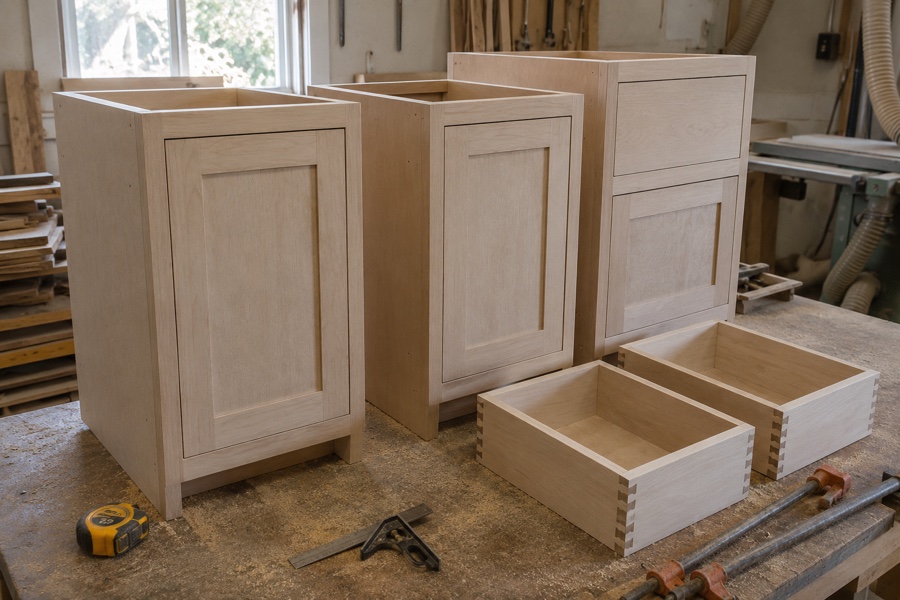
The Species We Keep on the Rack for Peninsula Work
Timber gets chosen for how it works and ages, not for how it photographs. Soft maple and poplar carry pigmented coatings: both mill cleanly, both are closed-grained, and poplar arrives streaked green and purple in a way that vanishes under primer. Hard maple is the denser cousin, pale and tight, and dents least of anything on the rack, which is why drawer sides come from it.
White oak behaves two ways depending on the saw: rift stock draws a straight, quiet line down a door, plain-sawn gives arching cathedral figure. Its pores are open, so a smooth painted film over oak wants filling first, and it warms toward amber. Walnut is soft for a hardwood, and its chocolate heartwood lightens with daylight while most timbers darken. Cherry does the reverse fast, deepening inside the first year, and blotches under a pigmented stain unless conditioned. Hickory is the hardest we cut and the most restless in color, near white to mid brown in one door.
Species drives the coating that suits it, the filling step it may need, and how a run of fronts is arranged so color reads as deliberate. Those calls get made together on paper, the part of specifying a whole kitchen that most repays care.
Drawer Boxes and the Hardware That Moves Them
A drawer works harder than anything else in a cabinet, so grade shows there soonest. Our standard box is solid hard maple, five-eighths of an inch thick, corners cut as dovetails, bottom captured in a groove on four sides so stored load rests in the joinery rather than on staples. A dado-and-glue plywood box is the honest step below; under that sits a chip-board box with its bottom pinned on, which sags once a household fills it.
Motion hardware sorts into three tiers, and every manufacturer sells all three, so the tier matters more than the brand. Entry means a coated side-mount runner on rollers, three-quarter travel, roughly seventy-five pounds, with sprung wrap-around hinges. Middle brings ball bearings and full extension, so the storage furthest in becomes reachable, at around the hundred-pound class, with concealed cups adjustable six ways.
Top tier hides the runners under the box and builds soft closing into the runner and hinge instead of clipping it on. These are rated in hundreds of thousands of cycles and adjust in three planes with the door hanging. You feel this tier daily and never see it, so it is the last place to save. Damp rooms get the same list, which is why bath cabinetry is specified from it.
Finish Systems We Spray for San Mateo Homes
Fronts are sprayed on racks in the shop and stay there until the film is hard. Three systems cover almost every order.
A painted system starts with a blocking primer that stops tannin and knots bleeding through, sanded flat, then two pigmented topcoats of a catalyzed or waterborne product. Paint is a film lying on the timber: exact color, species concealed, and one honest drawback, a knock reading as a pale mark.
A stained system has two halves people confuse. The color layer is either a dye, soaking into the fiber and leaving figure visible, or a pigmented wiping stain, lodging in the pores and evening color out. Blotch-prone timbers take a conditioning coat first. That layer is not protection; the clear coats over it are. A clear system splits two ways: a catalyzed clear builds a hard film that shrugs off water but can only be repaired by redoing a whole door, while a penetrating hardwax oil sits in the wood and accepts a spot repair at the counter.
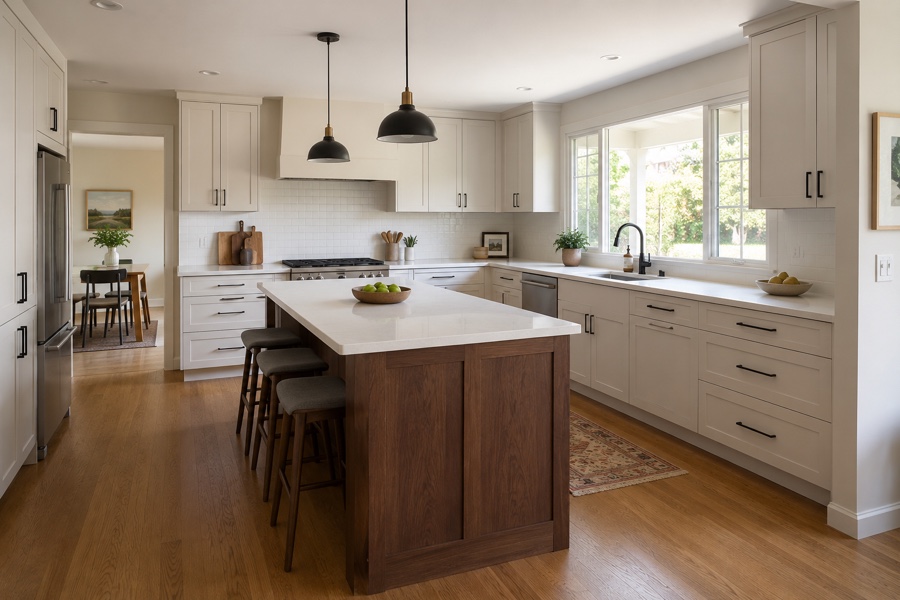
How a Finish Behaves After Four Years of Daily Use
Sheen is reflected light measured at a fixed angle, and the trade names climb in order: flat, matte, satin, semi-gloss, gloss. Where a coating sits on that scale changes durability less than people assume and appearance enormously.
Wear arrives in a predictable order whatever is on the door. Edges go first, starting at the bottom edge of an upper door where fingers hook underneath. Next comes the ring around each pull, where rubbing polishes a low-sheen film into a brighter patch. Then the shelf beneath a coffee machine, which takes heat and steam nobody plans for. Interiors barely change, because coated storage surfaces meet hands and little else. Two habits stretch a finish further than the specification does: dry the surface behind a damp cloth, since solvent cleaners dull satin, and deal with a chip while the damage is still only coating.
Fronts wear far faster than the carcasses behind them, which is the logic of changing only what you see when the boxes are sound. Sheet grade, species, hardware tier, and coating system are the four lines worth comparing across estimates, and where material money goes shows how far each shifts a total.
Frequently Asked Questions
Is veneer over plywood worse than solid wood for cabinet doors?
For a flat panel it is better, and the reason is seasonal movement. A board of timber swells and shrinks across its width as indoor humidity rises and falls through the year, and a wide panel glued up from solid stock can move a sixteenth of an inch or more between a damp February and a dry September. A veneered panel does not do that. The thin face is bonded to a core whose plies pull against each other in opposing directions, so the sheet stays the size it was cut. That is why traditional frame-and-panel doors float their center panel loose in a groove rather than gluing it: the joiners who invented that detail were designing around the same movement. Where solid stock still wins is anywhere an edge gets handled or shaped, so door rails and stiles, face frames, drawer sides, and applied moldings are milled from real boards. Flat panels, wide end panels, and every shelf in the storage interior are veneered sheet. Treating veneer as the cheap substitute misreads it. It is the material chosen because it holds still.
Which sheen level hides fingerprints and everyday wear best?
Matte and low satin hide the most, and the reason is that a rough microscopic surface scatters light in every direction instead of returning a clean reflection, so skin oil and small scratches have no smooth background to stand out against. Perfectly flat coatings go too far in that direction, because they polish where a hand rubs the same spot week after week and the polished patch around a pull ends up shinier than the door. Working recommendation by room: low satin on kitchen fronts, which is the compromise nearly every household lands on; satin or semi-gloss inside a bathroom, where the surface has to be wiped often and moisture matters more than fingerprints; matte on an island or a feature run where the look is the point and traffic is lower; and a harder semi-gloss on garage and utility casework, which gets washed rather than dusted. Color matters as much as sheen. A very dark front shows oil no matter what film is over it, and a very pale front hides oil but shows scuffs.
Does the wood species I choose change how long my cabinets take?
Sometimes, and the delay is almost never the milling. Painted work in maple or poplar runs on the standard shop schedule because those species move through local yards constantly and a sheet or a board is available the week it is ordered. The waits happen at the edges of the catalog. Rift-sawn white oak in a consistent color across a large order is the most common one, because rift stock is cut at a narrow angle to the growth rings and only a fraction of any log yields it. Wide walnut, quartersawn material of any species, and matched veneer sheet for a run of doors that must read as one piece are the others. A specialty species also lengthens the finishing end of the job, since blotch-prone woods need a conditioning step and open-pore woods need grain filling before a smooth painted film. The practical move is to settle the species while the drawings are still open, because that is the point where a two-week material wait costs nothing and a nine-week one is still avoidable.
Want to see the samples in person?
Free in-home consultation and a written quote. No pressure, no obligation.