Laundry and closet storage
Laundry Room Cabinets in San Mateo, CA
A laundry room is a storage problem dressed as an appliance problem. The machines take the same footprint whatever you decide, so every gain in the room comes from what surrounds them: cabinets overhead, tall storage beside the pair, a surface to fold on, and somewhere for the sorting to live that is not the floor.
Half the households asking have a room. The other half have a closet behind two doors.
Where Cabinets Fit Around a Washer and Dryer in San Mateo
The machines set the geometry and everything else gets drawn to them. What governs the layout is not the appliance width on the label but the space behind it: hoses, a duct, and the shutoff valves push the pair forward, and every cabinet inherits that offset.
Overhead is where laundry cabinetry usually goes wrong. A top-loading washer needs its lid to stand fully open, which shoves any cabinet above it out of comfortable reach, so shallow storage for rarely used items belongs there and nothing more. Over a front-loading pair the wall above is yours, at twelve or fifteen inches of depth so nobody knocks a head while leaning in, with a light underneath.
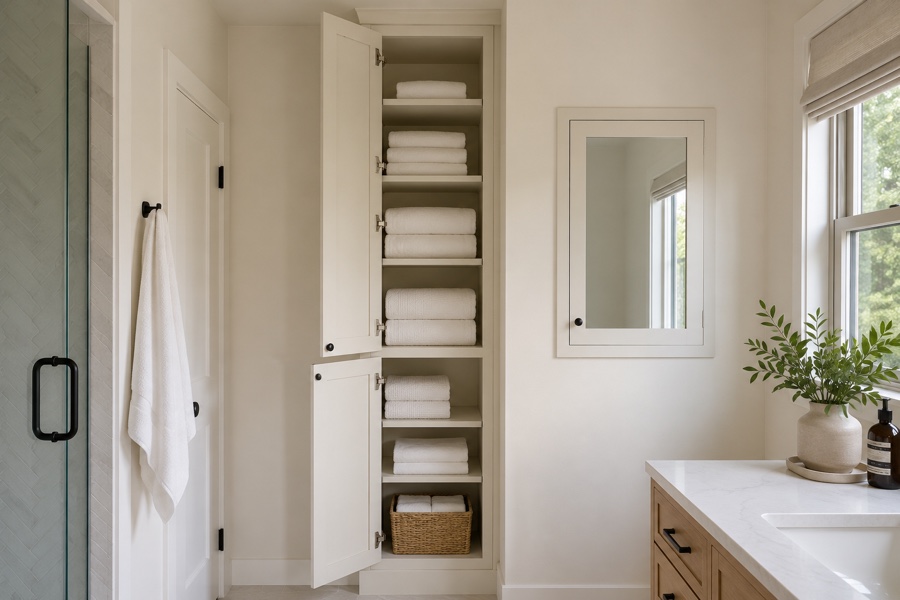
The strongest storage in the room is vertical and sits beside the machines. Eighteen to twenty-four inches of leftover wall where a run stops takes a full-height cabinet, and that single piece swallows the vacuum, the broom, an ironing board clipped to the door, and bulk detergent on adjustable shelves. Narrow gaps are not lost either: a nine-inch slot beside a dryer becomes a pull-out tower for the bottles that otherwise gather on top of the machines.
A Folding Counter Over Front-Loaders Earns Its Depth
One continuous top bridging both machines converts a corridor into a workroom. Clothes leave the dryer, land on the counter, and get folded there, instead of travelling to a bed in another room and staying until bedtime.
Front-loading machines are the entry requirement, because a lid hinged at the back cannot open under a fixed surface. After that, three details decide whether the counter lasts. Support comes from the room and never from the appliances: a ledger fixed into studs at the back, plus a cabinet or finished panel bearing the load at either side. Height gets settled after the pedestal question, since drawer bases under the machines raise the surface with them. And the top has to come away without a fight, usually fastened from underneath, so a service call does not turn into carpentry.
A low backsplash along the wall behind stops socks vanishing into the gap, a complaint that arrives roughly six months after a counter goes in without one.
Hampers, Drying Rods, and a Utility Sink Belong Inside the Cabinetry
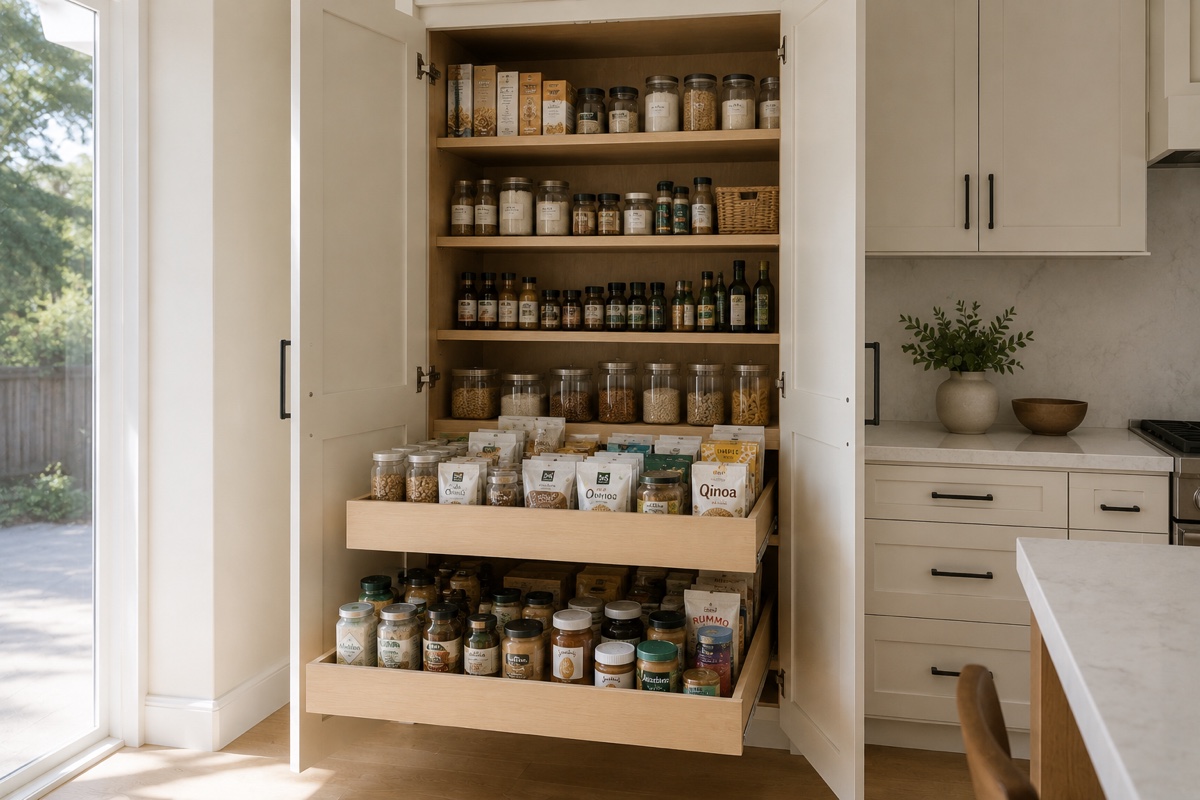
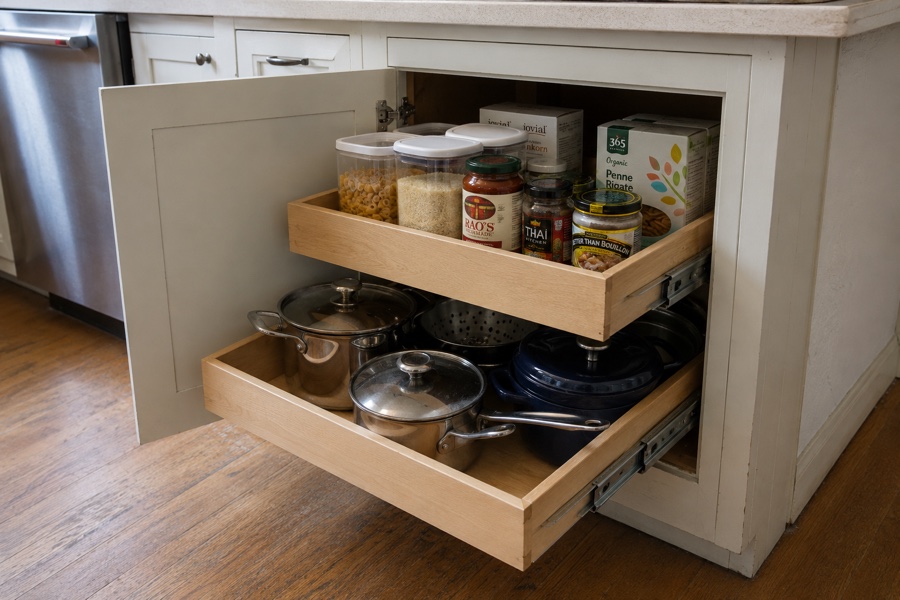
Sorting is what most laundry rooms lose to. Baskets multiply across the floor and the room stops working. Two or three canvas bags on a pull-out frame inside a base cabinet hold the same volume behind a door. Keep the carrier ventilated and the bags lift-out, since damp towels in a sealed box become a different problem.
Drying wants a rod rather than a rack. One inside a tall cabinet, over a drip-tolerant shelf, hangs the delicate items out of sight, and a second on a slide hides in a slim gap and vanishes once the load is dry.
Where a utility sink is going in, flank it. A sink base built around the trap keeps drawers usable underneath, a tall cabinet on one side takes the cleaning bottles with the harsh ones shelved above small hands, and a shallow unit on the other holds rags, gloves, and the stain kit. If the laundry doubles as the way in from the driveway, the bench, hooks, and boot cubbies covered on the back-door storage page belong in the same drawing.
A Peninsula Laundry Closet Asks for Shallower Cabinetry
Plenty of houses here never got a laundry room. The machines went into a hall closet, a niche off the kitchen, or a corner of the garage, and the doors are now part of the problem.
Bifold doors fold back into the opening and steal several inches of width at each jamb, so anything built inside sits behind that fold. Where the hallway allows a pair of swinging doors instead, cabinets can run the full width. Stacking is the other lever: a washer over a dryer frees a column as wide as one appliance, and that column suits a full-height cabinet with a rod, shelves, and detergent at eye level.
Depth stays tight here, so the honest answer is usually shallow uppers plus one tall unit rather than a wraparound. Keep the duct run clear, leave a gas dryer its combustion air, and treat the doors as trim, since a hallway sees them daily. Garage laundry corners carry damp on top of all that, so the material thinking behind cabinets built for an unheated bay applies, along with the sealed-edge approach used for cabinetry in rooms that see steam.
Four Things Set the Price of a San Mateo Laundry Fit-Out
Laundry cabinetry is quoted by the run and by what goes inside it. Enclosure comes first. Open shelving over a machine costs a fraction of the same width finished with doors. Moving parts come second, priced one at a time: every pull-out frame, hamper carrier, drying slide, and tray adds hardware and shop time, so a short list you will genuinely use beats a long one that looks good on a drawing. The counter is third, since a top spanning two machines needs support built for it and a surface that survives damp and heat. Site conditions are fourth: a sloped garage slab, a closet framed out of square, or a run that stops and restarts around a duct all add finished returns, and each return costs shop hours the drawing never advertises.
Plumbing for a utility sink, a gas line, and any new duct belong to other trades, and their work goes easier when the cabinet drawing is settled first. For how the same decisions price out in other rooms, see what cabinetry costs room by room. Adding a laundry run to a project already heading for the shop is the cheapest laundry work available: one machine setup, one spray run, and one delivery cover both.
Frequently Asked Questions
How much clearance do cabinets need above and beside a washer and dryer?
Begin behind the machines rather than above them. Hoses, a dryer duct, and the shutoff valves want four to six inches between the appliance back and the wall, and that gap decides where every cabinet in front of it lands. Above a top-loading washer the governing number is the raised lid: lift it, measure to the top edge, and hang nothing under that line, which often puts a shelf so high over that machine it stops being real storage. A front-loader has no lid to swing, so a cabinet can come down to within a hand width of the appliance top. At the sides, leave an inch of air so a spin cycle does not drum against a finished panel, and never build anything that prevents either machine from rolling straight forward. An appliance nobody can pull out is an appliance nobody can repair.
Can I put a folding counter over front-loading machines?
Yes, and it is usually the single biggest improvement available in the room, though four conditions come with it. The machines have to load from the front, since a top-opening lid has nowhere to swing once a solid counter runs over it. The room has to carry the top, never the machines, so a ledger goes into studs along the back wall and a cabinet or finished end panel bears the weight at either end. It has to clear the machine tops with a margin, and pedestals raise those tops by several inches, so settle the pedestal question before the height gets drawn. And it has to lift away or unbolt, because service means walking a machine out from under it. For surface, sealed hardwood, a laminate-clad panel, or a stone offcut all take damp and a hot iron. Bare fiberboard takes neither.
Is it worth building hampers and drying rods into cabinetry instead of buying freestanding gear?
For sorting and for drying, yes, because both jobs happen standing up in a narrow room where floor area is the scarce commodity. Two canvas sacks riding a slide-out carrier behind a base cabinet door replace three plastic baskets and take no floor at all, and the sorting disappears the moment the door shuts. A rod hung inside a tall cabinet, with a shelf under it to catch drips, gives the shirts that must never see a dryer somewhere private to hang. Two things are better bought than built. Anything with a motor belongs to a manufacturer who will sell you a replacement, and any hamper closed into an airtight box will smell by the second load, so ventilated backs and lift-out bags are the details that decide whether the built-in version is still in use three years on.
Nearby: back-door storage, cabinets for an unheated bay, or book a measure.
Ask us to measure your laundry room
Free in-home consultation and a written quote. No pressure, no obligation.