Living room storage
Custom Entertainment Centers in San Mateo, CA
An entertainment center is furniture that happens to be fastened to your house. San Mateo households call us when the television is perched on a console nobody sized for the room, the soundbar hangs off both ends of it, and a pile of black equipment lives on the carpet underneath. What we make instead is drawn to your wall, your seating, and your gear.
This page covers the unit itself: how tall it should sit, what storage goes inside, and how the equipment stays cool.
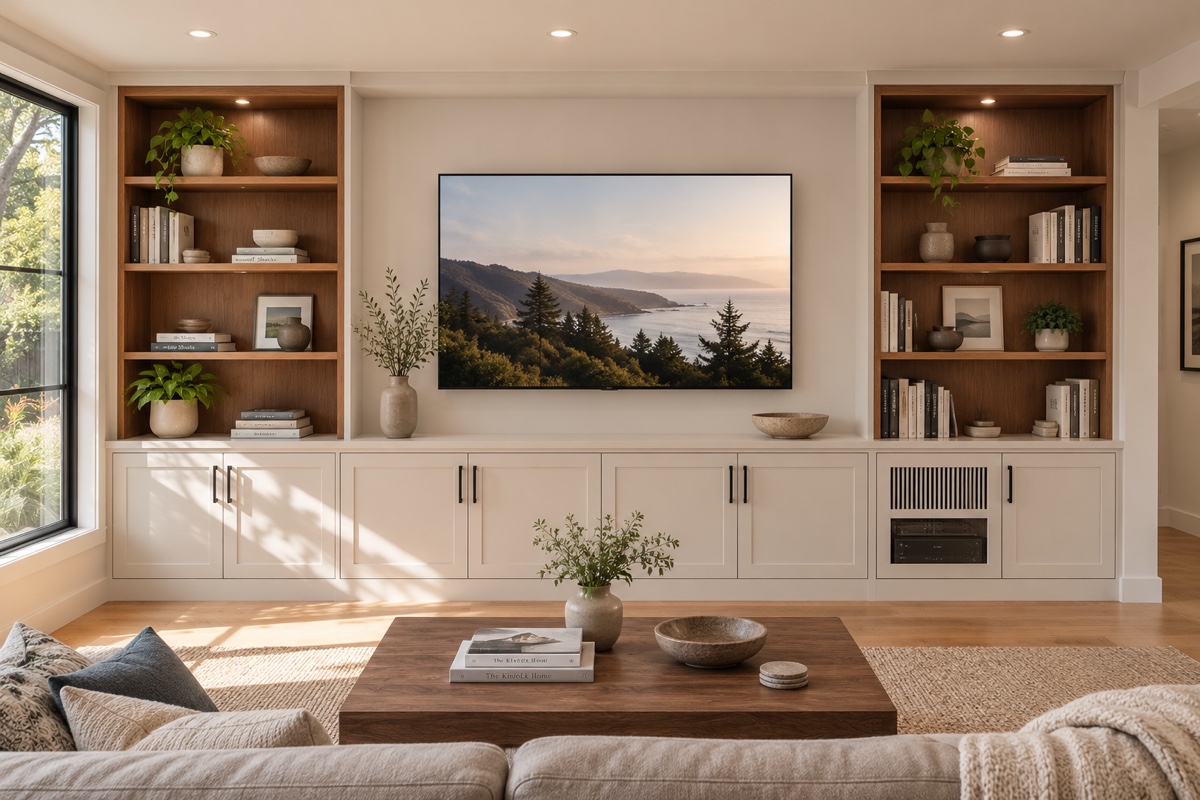
What Goes Inside an Entertainment Center in a San Mateo Living Room
Work out what the piece has to swallow before deciding how it should look. The storage list grew over the last decade, and almost none of it is the television.
Equipment first: a soundbar, a streaming box or two, a game console, sometimes a turntable, and the wifi router everybody wants hidden and nobody wants smothered. Then the loose things that make a room untidy: controllers on a charger, remotes, headphones, and the discs a family kept because the children still watch four of them.
Then the awkward category. Board games are what media storage most often gets wrong. A game box is wider than a stock drawer and taller than the dividers most cabinets ship with, so games get stacked on a shelf where the bottom one is never reached. One deep drawer drawn to a real game box settles that permanently.
That inventory sets the split between drawers and doors. Drawers below for the heavy and the loose, since you look down into a drawer and take in all of it at once. Adjustable shelving behind doors for the equipment stack, because component heights change whenever you replace something. A lined tray up top for remotes and controllers, wired for charging.
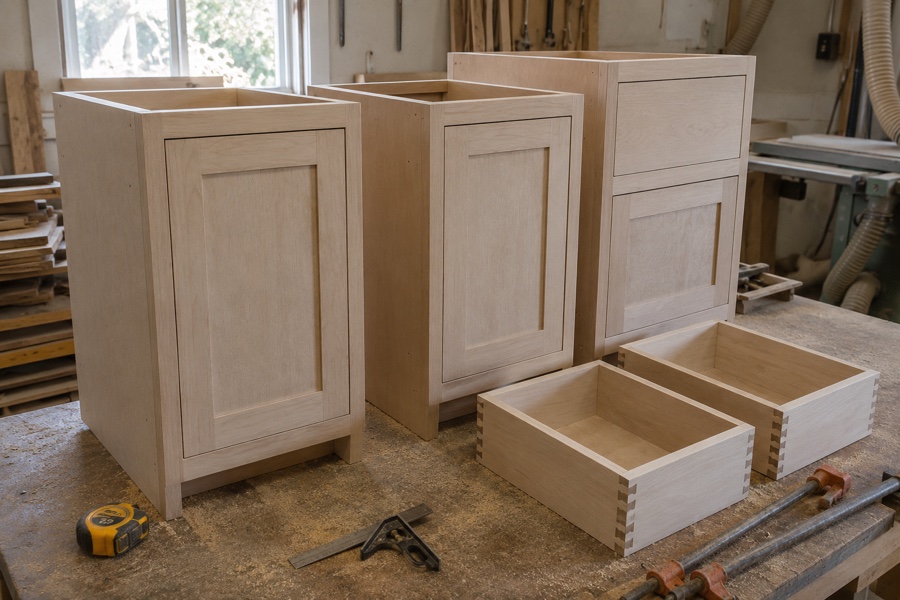
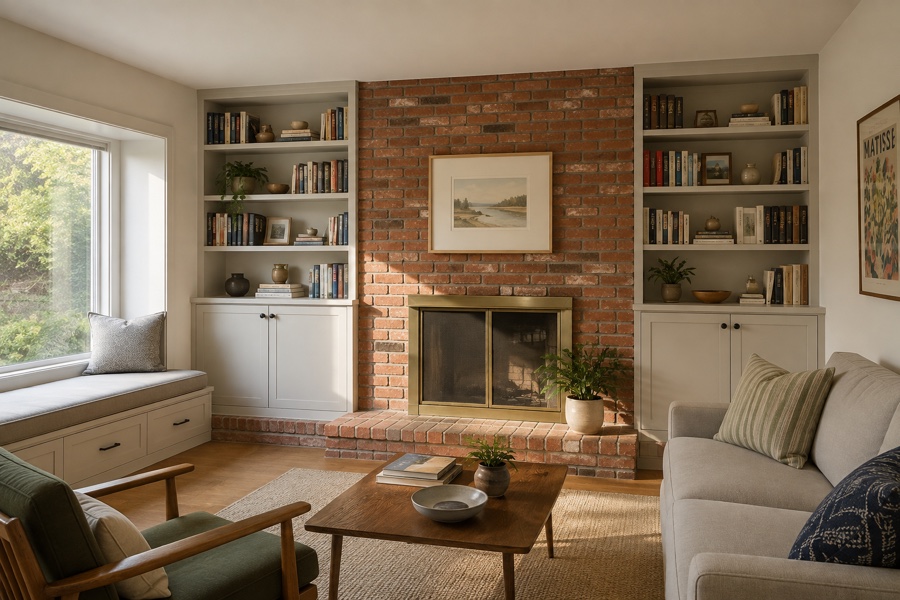
Three Shapes of Media Unit for Peninsula Living Rooms
Nearly every console-height piece we draw takes one of three forms, and the room usually decides which.
The television bench is the plain one and the most common: long, low, mostly drawers, set on a recessed kick or short legs, and run wider than the panel so the composition settles.
The floating console is the same carcass hung off the wall with nothing beneath it. A vacuum passes under in one stroke, a small room reads larger because the floor keeps running past, and it is the shape people ask for in the newer houses around Foster City. It also demands more of the wall: a cantilevered cabinet full of equipment needs solid blocking behind the drywall, so the hanging rail lands in wood rather than hollow board.
Fireplace-flanking lowers are the third. Two low cabinets sit in the alcoves either side of the chimney breast, capped at one height, with the mantel and everything over it left clear. Equipment lives in one, general storage in the other, and the fireplace stays the thing you look at.
Any of the three can grow upward. Once shelving climbs over the console and the piece becomes a whole elevation rather than a furniture-scale unit, it is a different build with a different budget, and casework that takes the entire wall is where that version lives.
Cool Equipment and Invisible Cables Are Design Decisions, Not Fixes
Both get solved on the drawing, weeks before anything is cut, and both cost real money to solve afterward. Airflow comes first. Warm air rises, so the stack is built to let it leave: the hottest component takes the top position, each shelf sits a generous gap above the box beneath it, and the back of the bay is either open to the wall cavity or fitted with a vented panel. Closed doors are fine so long as the compartment breathes somewhere, which is why a slot at the head of an opening or a fabric insert in a door panel does more good than it looks like it should.
Cables come second and are mostly geometry. We drill the chases and knockouts while the case is still parts on a bench, so every hole is clean and sealed rather than hacked through a coated panel on install day. A grommet lands where the screen wiring drops behind the piece, a vertical chase carries that run down inside the carcass, and the power strip mounts on a cleat inside the cabinet instead of lying on the floor. Every lead is cut with a service loop, so one component can be pulled forward without unplugging the rest.
Two of these want deciding before the drawings are signed. Where the television hangs over the piece, an in-wall conduit between the mount and the top of the case is the only route to bare plaster. And if the router lives in the unit, give it a storage compartment with a vented back, because a router in a sealed box is a slow wifi complaint waiting to happen.
Making Furniture-Scale Casework Look Right in a San Mateo Room
A media unit gets looked at from six feet away, seated, for hours at a stretch. Proportion and finish therefore take as much thought here as the storage plan.
The base detail sets the character. A recessed kick makes the piece read as part of the room itself and hides a floor that has settled, which matters in the older houses across the Peninsula. A leg base or an exposed plinth makes the identical carcass read as furniture and lets light travel under it. Neither is better; they answer different questions about whether the piece belongs to the house or to the room.
Top surfaces take abuse here that they escape elsewhere: drinks, feet, afternoon sun through an unshaded window, and the weight of a panel where the screen is not wall-mounted. We specify a harder finish schedule on the top than on the fronts, and in a room with strong western light we steer away from the woods that shift color fastest.
The wall over the console is the last decision, and leaving it empty is a legitimate answer. Where a household wants some storage there without the mass of full-height cabinetry, a pair of shelves hung with no visible brackets in the matching wood keeps the piece grounded and the wall light. Weighing that against a taller build, our page on what casework at this scale runs sets the two beside each other.
Frequently Asked Questions
How do I plan an entertainment center around my television size and how we sit?
Start seated, not standing. Sit where you actually watch, have someone hold a tape against the wall, and mark the height your eyes land on with your head relaxed. In most living rooms that mark falls near 40 inches off the floor, and the middle of the screen wants to sit within a few inches of it. Everything else follows from that one mark. Subtract half the height of your panel to find where the bottom edge of the glass has to land, then leave clearance for a soundbar if the bar sits on the top surface rather than under the screen. What remains is the height of the casework, which in practice lands between 22 and 30 inches for a piece you look over rather than at. Width is the easier decision: draw the unit wider than the panel by a comfortable margin at each end so the screen reads as centered on furniture rather than balanced on it. Bring the model number of the television to the measure. We would rather design around a real panel and a real bar than around a guess, and we leave the mounting plate adjustable sideways so the next screen fits without a saw.
How do you keep streaming boxes and game consoles cool inside a closed cabinet?
Heat is what kills equipment early in cabinetry, and the answer is airflow rather than a bigger box. We either leave the back board off the equipment bay entirely, so it breathes into the stud space behind, or fit a panel with vents cut into it, and then hold the shelves far enough apart that warm air climbs past each component instead of pooling under the shelf above it. A receiver or a game console under load throws off real heat, so those take the top position in the stack and the widest gap. Where a household games hard, we fit a small thermostatic fan on its own outlet inside the bay, which stays quiet and runs only when it needs to. Doors are compatible with all of that provided they are not sealed: a shallow gap at the base of the door, a cane or fabric insert, or a slotted rail at the head all let a compartment breathe while it looks shut. Signals get their own answer. Modern remotes on radio or wifi pass through wood without help, and for older gear that needs line of sight we run an infrared repeater with its receiver mounted on the face of the case, so a solid door costs you nothing.
Should I build a console-height unit or cabinetry that fills the whole wall?
Three questions settle it. First, how much do you need to put away? If the list is equipment, controllers, games, and a few blankets, a console holds it and anything taller is spending money on air. If the room also has to absorb books, games for a whole family, and the overflow from a house with no attic, the wall is doing more work and earns the height. Second, what do you want the room to look at? A console keeps the surface above it free for art, a mirror, or nothing at all, and rooms with good light or a view usually read better that way. A full elevation makes the television side of the room its subject, which is right in a den and often wrong in a formal front room. Third, what is the wall already doing? Windows close to the corner, a return air grille, a radiator, or a low ceiling all argue for the low piece. Blank plaster between two doorways argues for the tall one. When the honest answer is both, we draw the console first and design it so shelving can be added over it later without touching the base.
Keep reading: fitting cabinetry you already own, or book a visit.
Get a free in-home consultation for your media unit
Free in-home consultation and a written quote. No pressure, no obligation.