Repairs
Kitchen Cabinet Repair in San Mateo, CA
Repair is what keeps a kitchen you otherwise like. A crooked door that refuses to stay adjusted, a drawer dragging or shorn of its front, a sink base soaked by a slow leak, a chipped edge where everybody knocks it: none of that calls for a new kitchen.
We put existing cabinetry right in San Mateo, and in the Peninsula towns either side of it, on storage we built and on storage somebody else did. Below: what gives way, what each fix involves, and where repairing stops making sense.
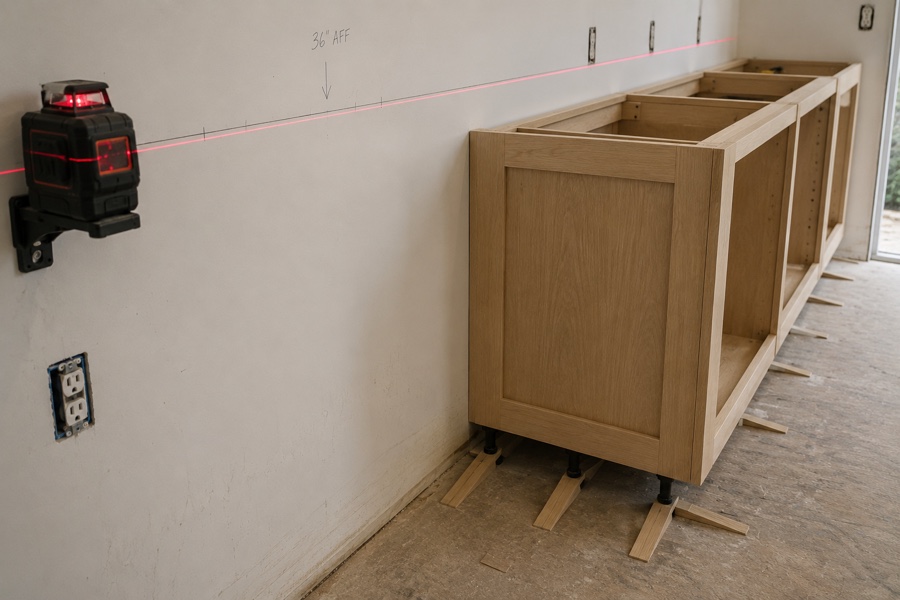
Cabinet Repairs San Mateo Households Ask About Most
Nearly every request lands in one of six places.
Doors that sag, rub, or sit out of true in their openings. Drawers that stick, tip forward, or have parted company with the front screwed to them. Sink cabinets gone soft underfoot. Face frames slack at a glued joint. Finish chipped along an edge. And the one cracked front spoiling a tidy run.
What ties them together is that the cabinet stays. Nothing leaves the wall, the counters and plumbing above go untouched, and only the storage around the work comes out.
It is also why looking beats quoting blind. A hinge that will not hold might mean a screw hole worn oversize, or a stile split behind the plate, and those are different jobs.
Hinges, Slides, and Slack Frames Come Back Into Line
Most door complaints are hinge complaints. A cup hinge moves in three directions, so a front out of square with its neighbors is often a driver away from sitting right again. When the adjustment runs out of travel, the cause is underneath it: a hole worn wide, or a front heavier than the hardware beneath it can carry. Plugging that hole with glued hardwood and boring it afresh gives the screw new material to bite.
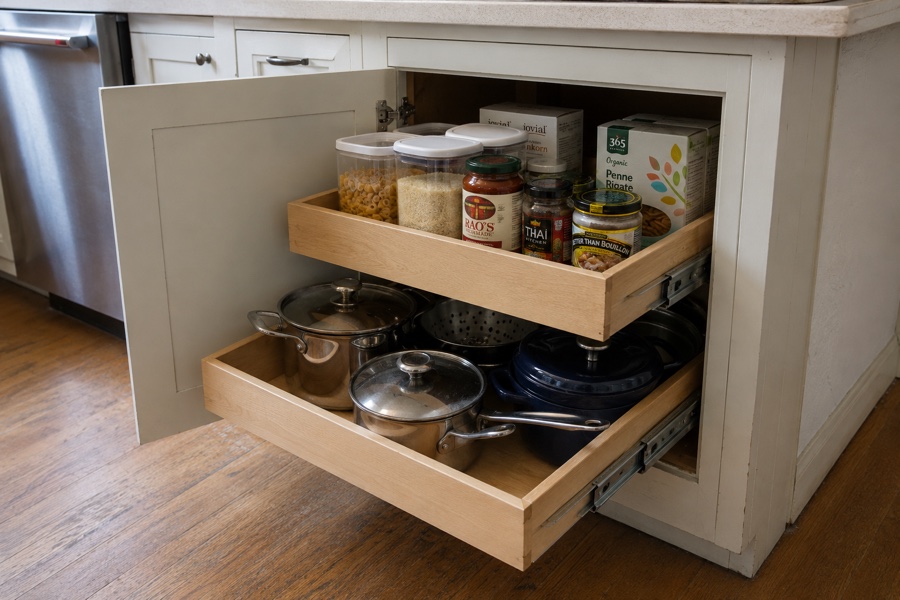
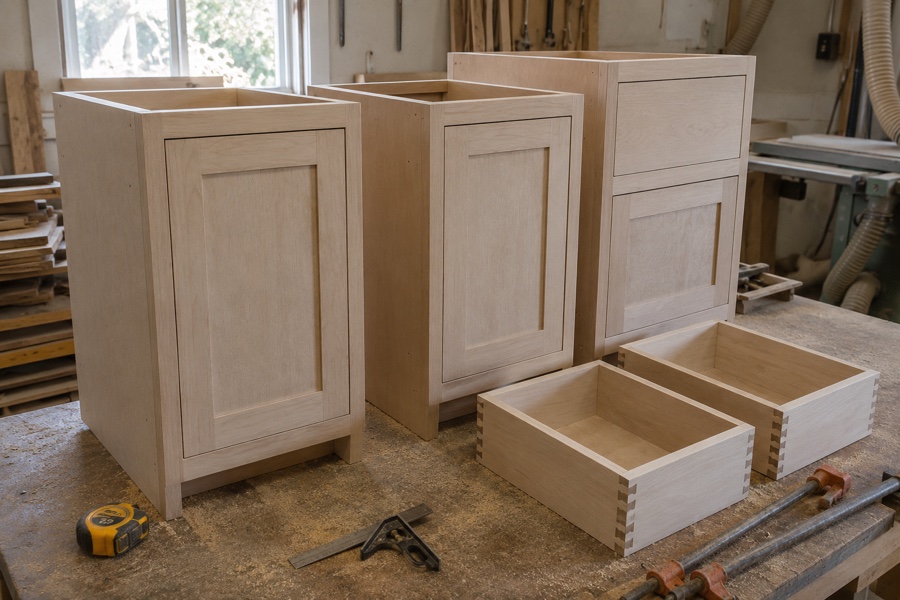
Drawers give way in their own fashion. Older runs ride on bottom-mounted steel that has lost its glide, or on wooden runners worn into a trough, and either can be swapped for full-extension hardware without disturbing the cabinet face. A box whose bottom has dropped or whose corners have opened is reglued, or rebuilt to identical outside dimensions so the front and slides go back on.
Frames slacken at their joints when a run has been racked by a settling house. Clamps, glue, and a concealed pin put that right, and it has to happen before any door hung there will hold its alignment.
Water Under a Sink Ends More Peninsula Cabinets Than Wear Does
When a cabinet case has genuinely failed, use is rarely the culprit. A supply line wept behind the basin, a disposal seal let go, or a waste pipe dripped quietly for a year, and the floor took all of it. Above the counter, everything looks fine.
Material settles what happens next. Plywood takes a soaking, dries, and generally keeps enough integrity to hold a fastener, so the wet deck comes out and a sealed panel goes in on cleats. Chipboard has no such recovery: swelling breaks the bond between the chips for good, and every screw hole turns to powder.
Either verdict keeps the damage contained: one case is rebuilt in place while the runs to its left and right stay fastened where they are. Plumbing comes first, since an untraced leak ruins a new floor too.
Vanities go the same way and sooner, since a small room stays humid after every shower.
Repair Suits More San Mateo Kitchens Than People Assume
Three routes exist and they do not really compete. Each answers a different kind of failure.
-
Repair
Cases are square, dry, and still grip a fastener, and what has given up is hardware, a glued joint, a finish, or one front. Nothing sound gets thrown away.
-
New fronts
Everything opens and shuts properly and the room simply looks tired at every opening at once. The complaint is skin deep rather than structural.
-
New boxes
The plan is wrong, the storage falls short, or the cases have gone soft throughout. No repair on this page reaches any of that.
Price the middle route before dismissing it, since fresh fronts hung on the boxes you already own covers every opening in one pass. If the cabinets are bought and stacked in the garage, fitting cabinetry ordered elsewhere is a service of its own, and what new cabinetry runs here puts figures beside the comparison.
Repairs are quoted item by item, so a short list stays cheap. Once a kitchen wants eight hinges, four drawer boxes, a sink base, and three fronts, the sums have usually crossed over.
Frequently Asked Questions
Can one damaged door or drawer front be matched to the rest of my kitchen?
Usually, and painted work matches far more easily than stained. The replacement is built to the same profile and dimensions, then sprayed to a color read off a front taken from your own cabinet. Old paint has shifted under years of light, so a flawless match on a single opening is rare, and hanging the new piece away from the brightest window hides the rest of the gap. Stained hardwood is harder, since grain and color both have to agree.
Is a swollen sink base repairable, or is that cabinet finished?
It depends on the material and how far the water travelled. Plywood that has dried out and still grips a screw is worth saving: the ruined deck is cut away and a sealed panel takes its place, with the sides and the face frame untouched. Chipboard that has swelled is past saving, since the fibers never knit back together and a fastener has nothing left to bite.
How do I decide between repair, new fronts, and new cabinets?
Ask what has failed rather than what the kitchen looks like. Sound cases with worn hardware, a slack joint, a chipped edge, or one broken front point at repair, the cheapest of the three by a distance. Nothing broken but every surface dated points at fronts. Short storage, appliances in awkward places, or bottoms that flex underfoot point at new cabinetry instead. Between two answers, count the failing items and let the total decide.
Find out what your cabinets actually need
Free in-home consultation and a written quote. No pressure, no obligation.