Refacing
Kitchen Cabinet Refacing in San Mateo, CA
Refacing is work we do for households in San Mateo and the Peninsula towns around it, and we build replacement cabinetry too, which means we have no reason to push you toward the bigger job. It suits a home whose cabinet boxes are still sound and whose layout and storage still work: you get a room that looks new, for roughly half the cost of one that is new, without moving out of your kitchen for two months.
Whether that describes your kitchen is a question about your cabinet boxes, not about your taste. Below is how to inspect them, what the answer costs either way, what you can have on the front of them, and which storage upgrades are worth adding while the doors are off.
What Actually Happens During a San Mateo Cabinet Refacing Job
Refacing is often described in a sentence and then left vague. Here is the physical sequence, in the order it happens in your house, so you know what you are buying.
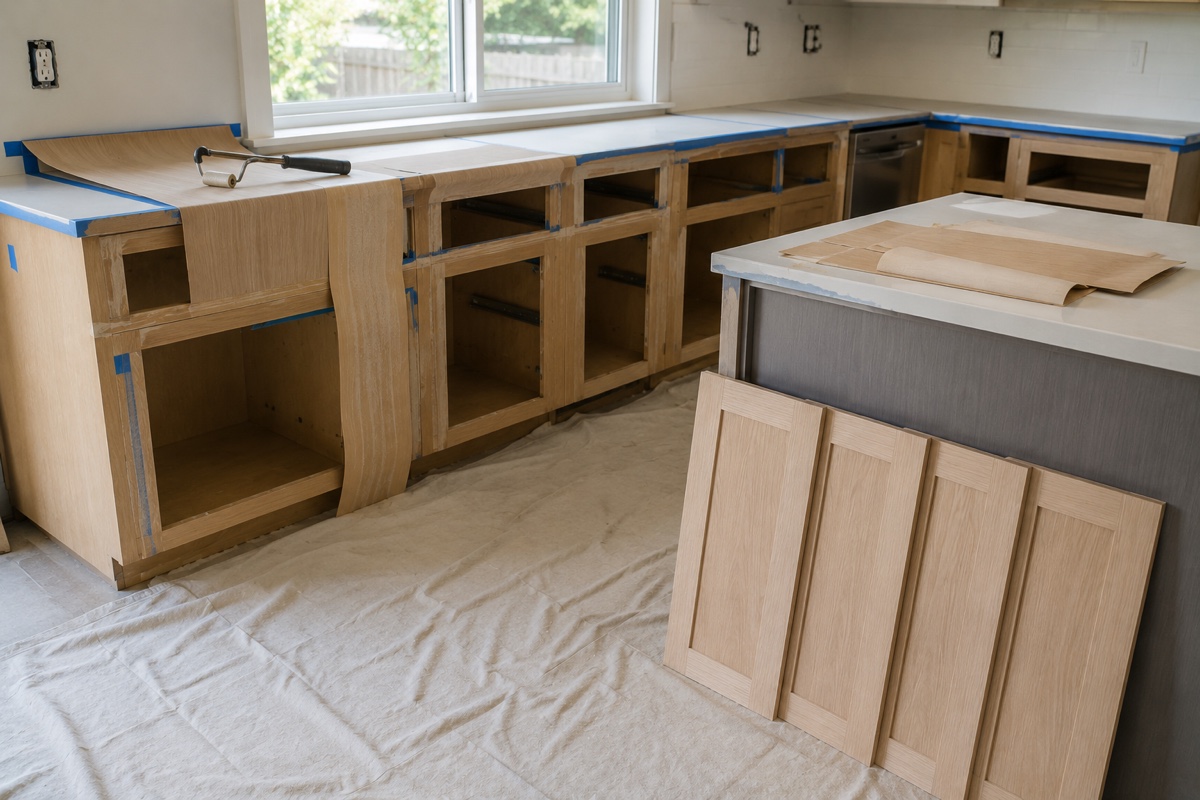
Day one, the old fronts come off and go in the truck. Doors, drawer faces, hinges, and pulls are all removed and discarded, and the openings are measured again with the fronts gone, since the numbers we cut to come from the bare frames rather than from the doors that used to cover them.
Next, the carcasses get prepared. Old hinge cups and hardware holes are filled. Face frames are scuffed, cleaned, and any loose joints re-glued or pinned. This is quiet, unglamorous work and it is where a good reface separates from a bad one, because a skin applied over a dirty or waxed frame will lift at a corner within a year.
Then the visible carcass surfaces are covered. Face frames receive a matching skin, and the exposed sides of end cabinets, plus any panel visible beside the refrigerator, get a finished panel rather than a wrap. Interiors are left as they are, which is worth saying plainly: your interior storage does not change unless you ask for new shelving or rollouts, and having the doors off is the cheapest moment there will ever be to add that storage.
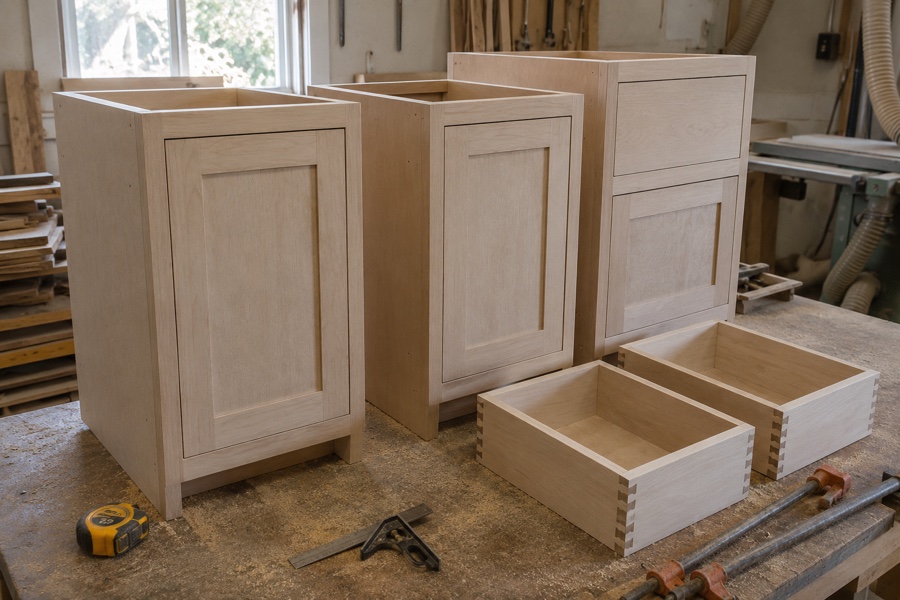
Finally the new fronts go on. These were built and finished in the shop weeks earlier, never sprayed in your kitchen. Every door gets bored for the correct cup hinge, hung, and tuned until the gaps between fronts match all the way along, and drawer faces are set to a consistent line rather than to the drawer box behind them. New pulls and knobs go on last. Toe kicks and light rail can be re-skinned in the same pass.
What refacing never touches: the position of the boxes, their height, their depth, the amount of storage they hold, the counters, the sink, the appliances, and anything inside a wall. If your complaint is on that list, refacing cannot solve it, and the next section will tell you so.
Inspect Your Cabinet Boxes Before Refacing a San Mateo Kitchen
Refacing is a bet on the carcasses already screwed to your walls, plus the storage inside them staying as it is. Make that bet with evidence. You can gather most of it yourself in about ten minutes, with a flashlight and a screwdriver, before we ever come out.
Open a door and look hard at the cut edge of the cabinet side where the hinge mounts. Press the floor of the cabinet under the sink with your thumb. Pull a drawer all the way out and look at how it is joined at the corners. Lift out a shelf and see whether it has taken a bow under what it was storing. Set a small level on a run of face frame. Then take a photograph of anything that looks wrong and match what you found against the table below.
| What you find | What it means | Verdict |
|---|---|---|
| Cut edges show thin layers of veneer stacked together | Plywood carcass. It holds a screw under shelving loads and tolerates a damp week. | Reface |
| Cut edges look like pressed chips under a thin printed skin | Particleboard carcass. Hinge screws strip and shelves bow under load. | Replace |
| The floor of the sink cabinet flexes, or is stained and swollen | A supply or drain leak got into the box, usually years ago. | Replace that cabinet at minimum |
| Doors sag or refuse to stay aligned after adjustment | The face frame has racked out of square with the carcass. | Replace |
| Everything works, you just cannot stand looking at it | Your complaint is finish, not structure or layout. | Reface |
| You want the sink, range, or refrigerator in a different place | The carcass positions are the layout, and refacing keeps them. | Replace |
| Uppers stop at a soffit and you want storage to the ceiling | Carcass height is fixed. New fronts will not add a shelf of storage. | Replace |
| Boxes are sound but the storage inside is a mess to reach into | A fixable storage problem behind an unfixable-looking exterior. | Reface, and add rollout storage while the doors are off |
Mixed results are normal and they do not force an all-or-nothing choice. A kitchen with sound boxes and one water-damaged sink cabinet gets that single carcass rebuilt and the rest refaced, which is a common job for us and costs far less than the sentence suggests. What does force a replacement is any answer in the layout rows, because no front we hang will move a cabinet six inches to the left or add a foot of storage above it.
Housing stock matters here more than most people assume. Kitchens from the 1960s and 1970s in Foster City and parts of Redwood City were frequently built with plywood carcasses, which makes them unusually good refacing candidates. Kitchens redone on a budget in the 1990s are the opposite case: the boxes are often particleboard, and they are the ones we most often advise replacing. When the verdict comes back replace, custom kitchen cabinets sets out what building new actually entails.
In San Mateo, Refacing Costs About 40 to 60 Percent of Replacing
That ratio is the most useful number on this page, because it travels. It applies to a small kitchen and a large one, to a plain scheme and a detailed one, and it lets you price your own decision before anyone quotes you.
Work it as a proportion. Whatever a replacement would cost in your kitchen, take somewhere between two-fifths and three-fifths of it, and that is the neighborhood a reface sits in. A kitchen that would cost $28,000 to rebuild in new cabinetry typically refaces somewhere around $11,000 to $17,000. A larger kitchen that would run $50,000 to replace refaces nearer $20,000 to $30,000. In practice the great majority of San Mateo refacing jobs fall inside a $9,000 to $25,000 window.
Where you land in the 40 to 60 percent spread is not random. Three things pull toward the bottom of it: fewer openings, laminate or thermofoil fronts, and boxes that need almost no preparation. Three things push toward the top: a high door count, stained hardwood veneer that has to be grain-matched across the run, and a kitchen with lots of exposed end panels and finished sides. Refacing a bathroom vanity alongside the kitchen is cheap to add, since the fronts join the same finish batch.
Two costs sit outside the ratio entirely. Interior storage upgrades such as rollouts and new shelving are priced separately and are worth doing during the reface rather than after. And rebuilding a failed carcass is cabinetry, not refacing, so it is quoted as cabinetry. If you want the replacement side of that comparison costed out, the custom cabinet cost guide does it room by room. And if you have already decided on new boxes, cabinet installation covers fitting cabinets you buy elsewhere.
One last piece of arithmetic that has nothing to do with cabinetry. If you are refacing to sell, the ratio is the argument: on a Peninsula listing, a kitchen that photographs well matters, and refacing buys most of that appearance for roughly half the outlay. If you are refacing to live with it for fifteen years, look harder at the layout rows in the table above, because the things refacing cannot fix, storage among them, are the things that annoy you daily.
Cabinet Repainting and Refinishing: When Paint Alone Is Enough
Refacing is not the cheapest way to change how a kitchen looks. Repainting is. If the doors and drawer fronts are solid wood or MDF, still flat and square, and the profile still suits you, then the complaint is color, and color is the only thing that has to change. Fronts come off, get cleaned, deglossed, filled where the old hardware sat, and sprayed in the shop, while the face frames are coated in place. Refinishing takes the same route on stained wood, stripping and recoating rather than covering. Paint cannot change a door profile, save a lifting thermofoil front, or restore a damaged face frame. When any of that is true the fronts get replaced, which is refacing. We repaint across San Mateo and Burlingame, and we say at the inspection which of the two a kitchen needs.
Door Styles, Woods, and Finishes for Refaced Cabinets
The fronts are the whole visible kitchen after a reface, so this is where the decisions are. Four families of material cover almost everything we hang.
Painted wood doors are the most requested by a wide margin. A solid frame with a flat MDF center panel stays dead flat, sprays evenly, and never shows a panel seam under the color. Shaker is the default profile and it suits nearly every Peninsula house, from a Burlingame Craftsman to a post-war ranch. Matching skins for the face frames are finished in the same batch, so the color agrees everywhere.
Stained hardwood is the premium route and the fussiest. White oak, walnut, and cherry all reface beautifully, and the skill is in the veneer: the frame skins have to match the door grain and color closely enough that the eye reads one material. We sample this before you commit, and we tell you where the match will be hardest, which is usually a wide end panel beside a busy door.
Rigid thermofoil is the value option, and it is better than its reputation. A vinyl film is heat-formed over a shaped MDF door, giving a seamless surface with no joints to collect grease. It cleans easily and holds color. Its weakness is heat, so it wants a heat shield beside a wall oven, and a damaged door is replaced rather than repaired.
Laminate and thermally fused panels are the durable, contemporary choice and the right answer over melamine boxes, where wood veneer will not bond. Slab fronts in a wood-look or a solid color read as modern, wipe clean, and suit the 1960s and 1970s houses on the Peninsula better than a traditional profile does.
Two details worth choosing deliberately. Hardware is the cheapest thing on the whole list and it changes the room more than the door profile does, so spend a little there. And hinges should be new soft-close cup hinges rather than reused originals: they are what makes a refaced kitchen feel new rather than resurfaced. If your project also includes a bathroom, custom bathroom cabinets explains where building beats refacing in a small wet room, and the cities we serve confirms whether we reach your street.
Frequently Asked Questions
How much does cabinet refacing cost in San Mateo?
Most refacing jobs in San Mateo land between $9,000 and $25,000, and the useful way to think about that figure is as a percentage rather than a number. Against a full replacement it runs 40 to 60 percent, which anchors the price of your reface to the size and detail of the kitchen you already have. Door count is the main driver, since every door and drawer front is a separate piece to build, finish, and hang, and a kitchen with twenty-two openings costs more than one with fourteen. Material comes next: laminate and rigid thermofoil fronts are the least expensive, painted wood sits in the middle, and stained hardwood veneer costs the most because the grain has to be matched across the run. Counters, appliances, flooring, and any plumbing or electrical work are not part of refacing and are not in those figures. Every number here is a typical range. Ask for a written quote before you plan around any of them.
How long will my cabinet boxes last after refacing?
As long as they were going to last anyway, which is the honest answer and also the whole point of inspecting them first. Refacing does not strengthen a carcass or extend its life. A three-quarter-inch plywood box built in the 1960s that is still square, still dry, and still holding its screws will very likely outlast the doors we hang on it, and there are plenty of those in Peninsula kitchens. A particleboard box with a swollen bottom is on a clock, and putting new fronts on it spends real money on a case that will need replacing anyway. The one thing refacing does change is load. New solid wood doors can weigh more than the originals, so we rebore for the correct cup hinges and, where a stile is thin or the material is marginal, reinforce the mounting point rather than trusting a screw into old chipboard.
Can you reface laminate or melamine cabinets?
Yes, with one important restriction on materials. Laminate and melamine surfaces are slick and non-porous, and wood veneer does not bond reliably to them, so we do not skin those face frames in wood veneer no matter how good the doors look in the showroom. What works instead is a rigid thermofoil or a laminate skin over the frames, paired with fronts in the same family. That combination bonds properly and gives you a durable, wipeable kitchen. If you have your heart set on stained wood, the frames need a different approach: either a solid wood overlay applied to the frame faces, or replacement of the cabinets. We check the substrate at the consultation with a scraper in an inconspicuous corner and tell you which of those three routes your kitchen supports before you choose a door.
How disruptive is refacing, and how long does the work take?
Far less disruptive than a replacement, and that is one of the main reasons people choose it. Your fronts are built and finished before anyone arrives, which takes roughly 3 to 5 weeks after you approve the sample and the measurements. On-site work is then 3 to 5 days in a normal kitchen. Through nearly all of it you keep your counters, your sink, your appliances, and your cabinet interiors, so you can cook, though the boxes stand open for a couple of days in the middle while the frames are prepared and skinned. Expect sanding dust and expect to empty the cabinet fronts of anything you do not want dusted. There is no demolition, no haul-away of carcasses, and no gap where a kitchen used to be. Compared with a full replacement, that is the difference between a noisy week and a season of cooking out of a microwave.
Also useful: the 2026 cost guide, garage cabinets, or ask for an inspection visit.
Find out whether your cabinets are worth refacing
Free in-home consultation and a written quote. No pressure, no obligation.