Design trends
The Kitchen Cabinet Trends Worth Building Now
A survey of the cabinetry details that genuinely read as current, written for Peninsula homeowners who want a room of its moment without buying a fashion that expires. Each trend here shares one quality: it is a construction decision as much as a styling one, so it has to be settled on paper before anything gets milled.
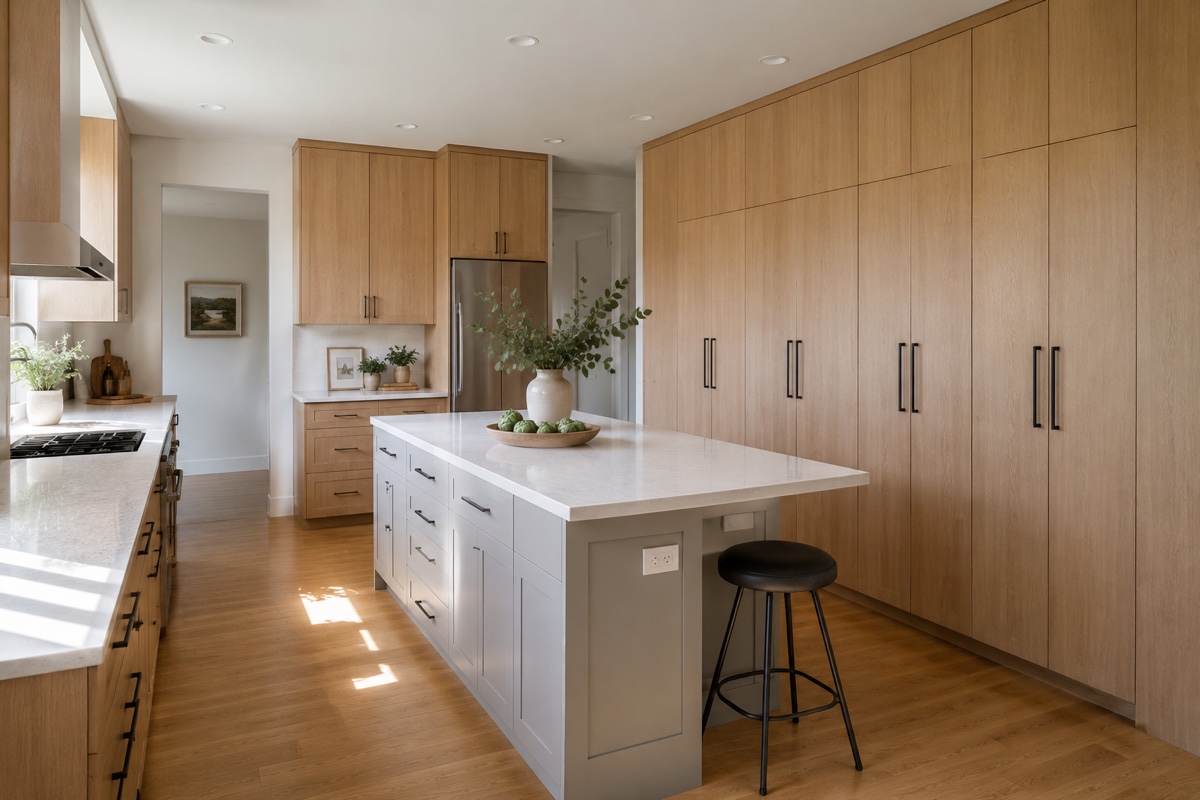
Fronts That Lose Their Handles
The clearest sign a kitchen was drawn recently is what has gone missing from its doors. A slab front carries no frame, no raised panel, and no molding, so a row of them reads as one continuous plane of material. Strip the pulls off that plane and the eye stops counting units and begins reading a wall.
Three mechanisms deliver it. Push latches release on a press and need no metal on the face whatsoever. An integrated pull mills a finger channel into the top edge of the front itself, so the grip belongs to the door. A continuous rail profile tucks an aluminum extrusion behind the upper lip of every drawer, trading a grid of knobs for one horizontal shadow line. All three ask for tighter tolerance than a knob ever does, which is the practical case for kitchens built to measure: the look holds only while every gap along the run agrees with its neighbors.
Fluted and Reeded Fronts Put Texture Back
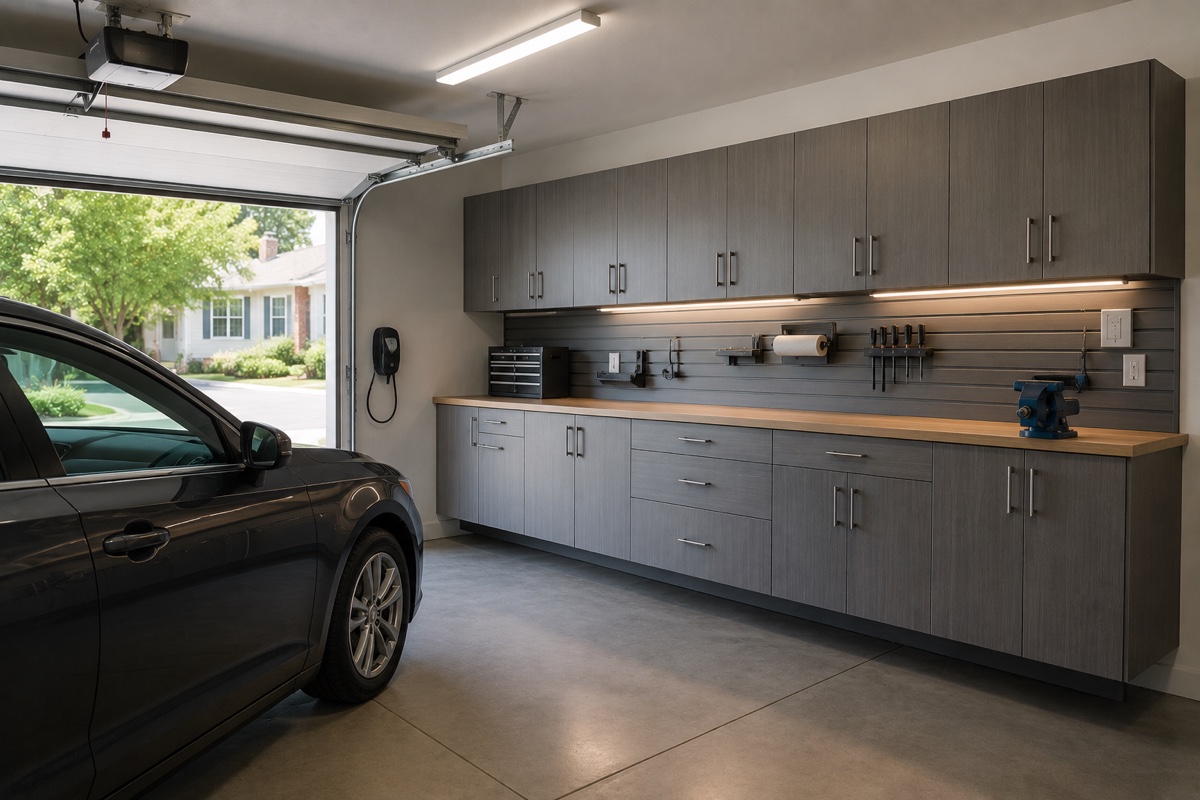
Flat everywhere turns cold, and the correction now arriving is milled relief. Fluting cuts rounded grooves into the face of a front; reeding pushes the identical rhythm outward as convex ribs. Either one catches a raking beam of afternoon light and hands a plain door a pattern of shadow that shifts hour by hour.
Placement decides whether it works. Milled across every front in the room, the detail becomes visual noise and a genuine dusting chore. Restricted to an island face, a hood surround, or a tall end panel, it functions as one deliberate gesture against quiet neighbors. Rift-sawn oak, ash, and walnut do most of the work in kitchens being drawn today, picked for straight grain rather than dramatic figure. Warm species with restrained detailing is what people mean by minimal but not clinical.
Appliances Behind Doors: Garages and Hidden Walls
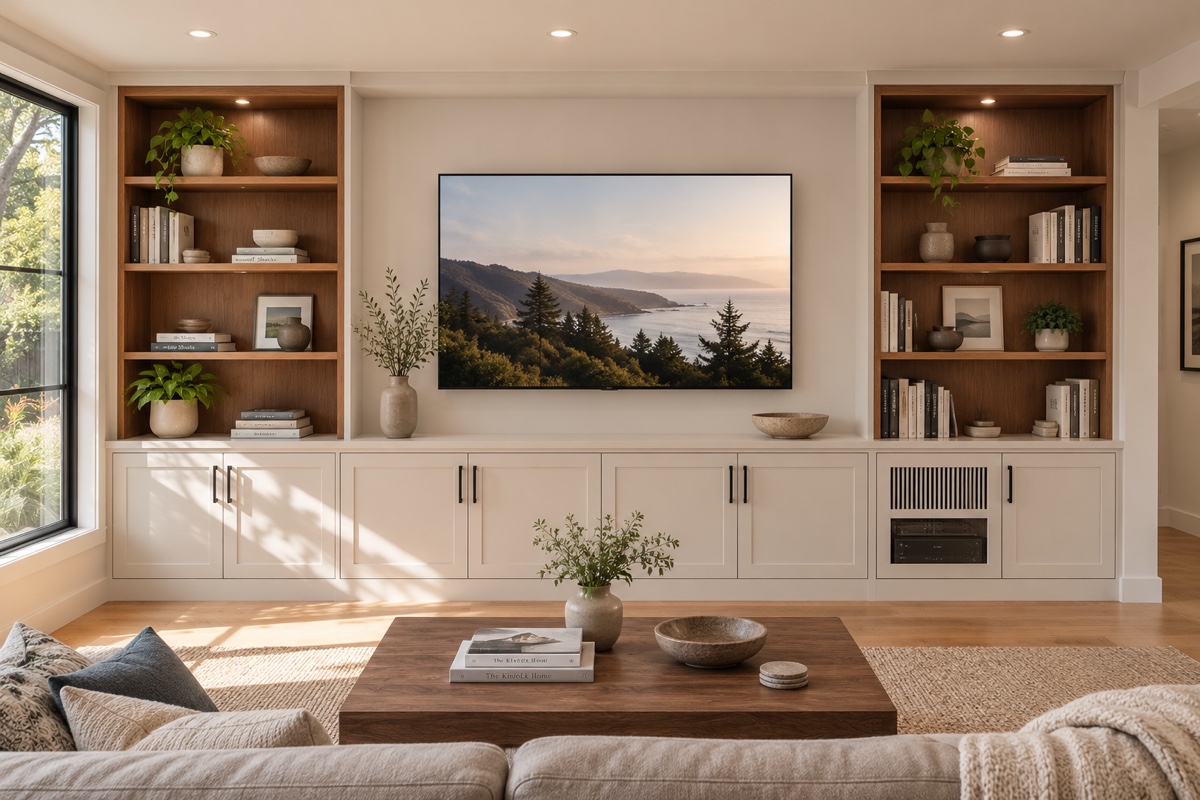
Kitchens photographed as modern look calm mainly because their counters are bare, and counters stay bare only when the toaster has somewhere better to be. Two related moves follow from that. Smaller machines get an enclosure with a tambour or pocket door and power inside, so the espresso maker stays connected and shuts away between uses. Larger ambitions produce a full-height run of flat fronts hiding dry goods, a coffee station, and sometimes a second prep counter. Open it and the working half of the kitchen appears; close it and the elevation reads as paneling.
Neither move survives being added late. Circuits have to reach the carcass before drywall closes, fronts have to fold or slide clear of the opening instead of blocking the aisle, and the interior wants drawing around real machines with their lids raised. Concealment also shifts money from visible surfaces into mechanisms, and our page on what each upgrade adds shows where hinges, slides, and interior fittings sit within a total.
Uppers to the Ceiling, Hardware in Two Metals
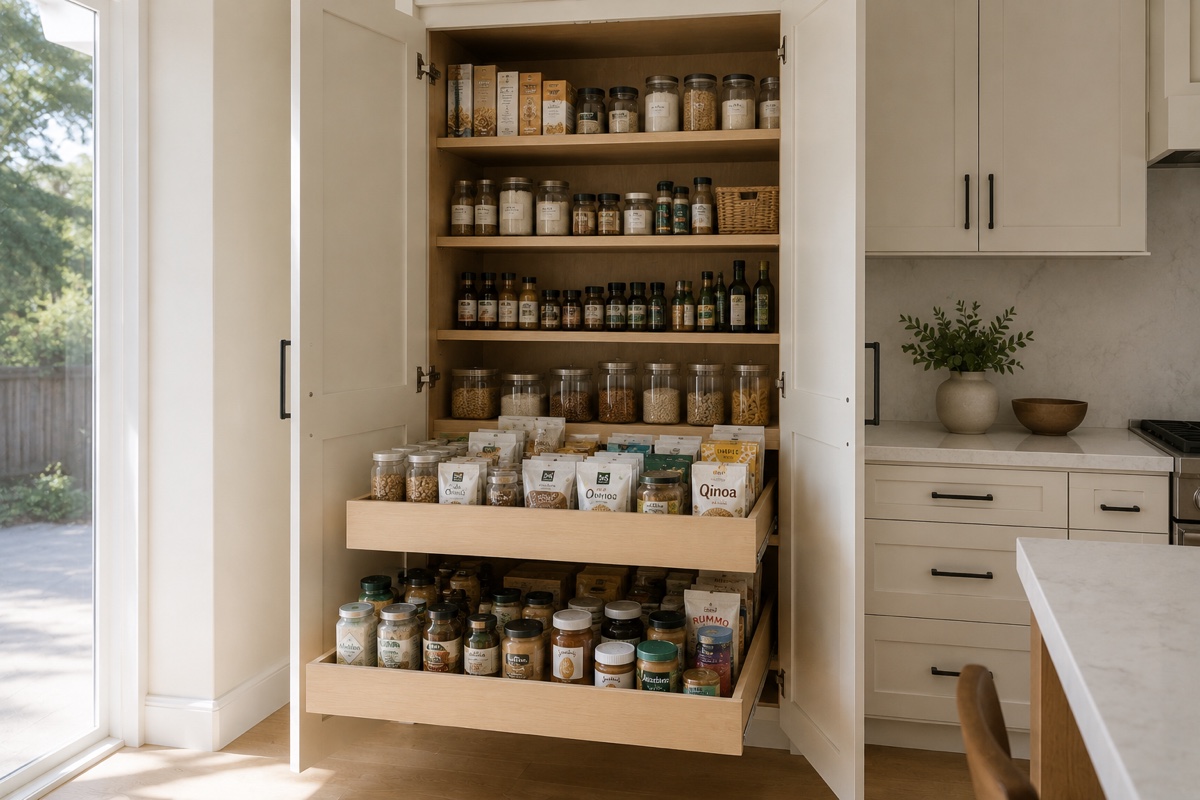
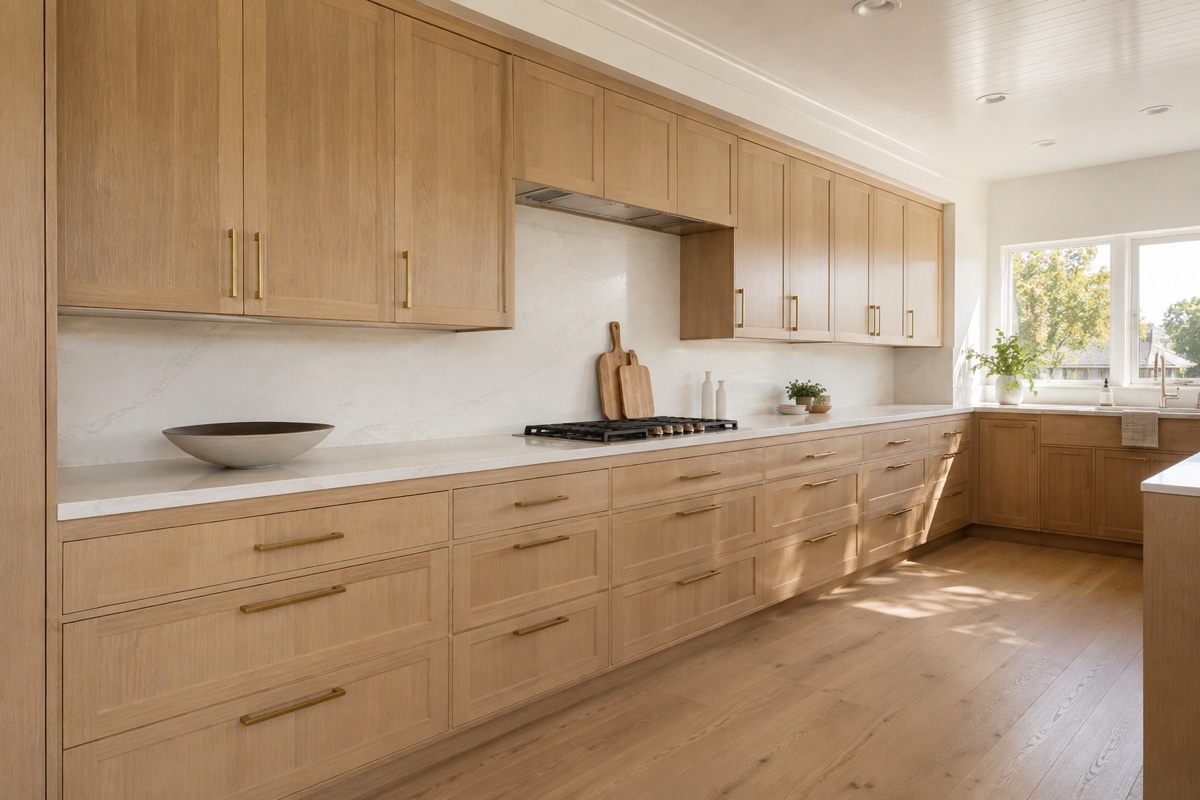
Two finishing decisions move a room further toward current than any door profile can. The first carries the wall units all the way up. That soffit, or the dusty ledge above a crown molding, is the most aging feature held over from recent decades; closing it yields a full extra shelf and, more valuably, hands the room one uninterrupted top line. The companion move deletes the tile. Where wall units run continuously and a single stone or porcelain panel climbs behind the range, no grout grid remains to compete with the joinery.
The second decision is hardware drawn from more than one metal. The rule that every finish in a room must agree has quietly lapsed. Brushed nickel around the perimeter with unlacquered brass on the island, or a dark matte on tall units against something warmer elsewhere, reads as considered rather than accidental, provided each metal repeats at least twice so it looks chosen. Hardware is also the least expensive trend to adopt, which is the same reason new fronts on sound boxes travels so far: the faces and the metal carry nearly everything a visitor registers as style.
Frequently Asked Questions
Are handleless push-to-open cabinets practical for a busy family?
Mostly yes, with two caveats. Push latches behave well on wall units and anywhere hands do not strike all day, and they keep smudges down because knuckles do the pressing. The trouble is deep lower drawers under load: a pan drawer that must be nudged closed and pressed again to release annoys anyone carrying a pot, and a child leaning on a front can spring it open. The usual compromise puts latches on the top run and mills finger channels into the base drawers.
Will fluted or reeded cabinet fronts look dated in five years?
Milled texture is decorative, so it carries more exposure than a plain front, and dosage controls that exposure. A whole room of grooved doors ties itself to one moment. The same milling on a single island face or one tall panel behaves as an accent, and an accent can be redone later without disturbing its neighbors. Fluting is also far from new, having returned through furniture in every generation since classical architecture. Restrict it to one or two surfaces and the bet stays small.
How do I bring a kitchen up to date without replacing every cabinet?
Work outward from the cheapest move. Changing pulls, or deleting them in favor of latches on the top run, alters how a room reads in one afternoon. Closing the void above the wall units comes next, because a soffit or an open dust ledge is the loudest age marker most kitchens have. Beyond that, new fronts fitted over bodies you already own covers most of the visual distance and skips the demolition. Wholesale replacement earns its place only where the plan is wrong or a carcass has failed.
Planning a kitchen that should still look current in ten years?
Free in-home consultation and a written quote. No pressure, no obligation.