Design trends
Modern Bathroom Vanity Trends That Hold Up Daily
A bathroom is small and its parts are few, so one new vanity rewrites everything a person sees. This article sorts the current modern looks into the ones that keep working after two years of wet towels and morning traffic, and the ones that only worked in the photograph.
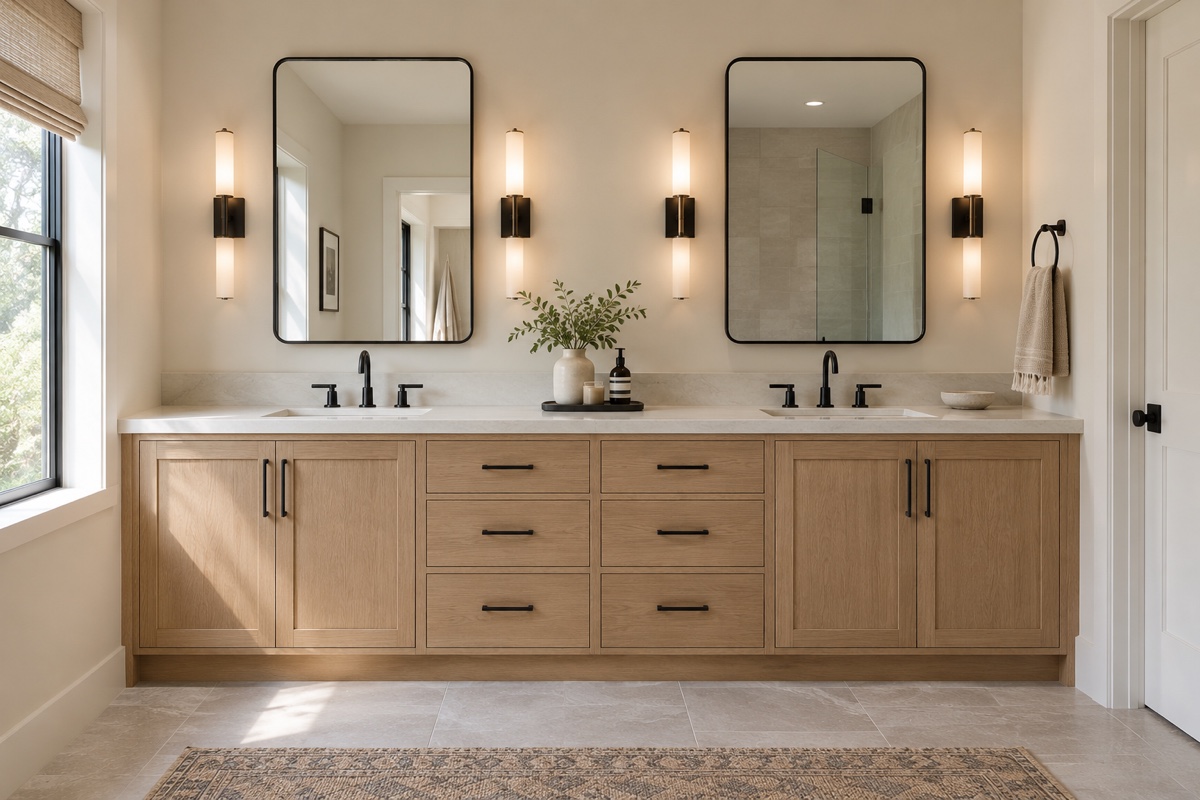
Wall-Hung Cases, Open Towel Niches, and the Light Underneath
The loudest trend right now is the vanity that never touches the floor. A wall-hung case leaves a band of tile running unbroken from the doorway to the far baseboard, and that visible floor is what gives a tight room air. No toe kick swells and no floor seam collects hair.
What makes it work is invisible. The case hangs on framing added while the wall is open, so it belongs to the drawing stage rather than a later change of mind. After that the rest follows: a shallow drawer riding over the trap, a deeper one beside it, and an open bay at the bottom sized for rolled towels. That niche costs less than the drawer it replaces.
Then the light. A warm LED strip set back under the case turns the shadow beneath a floating vanity into a glow and doubles as a night light. Details like that belong in the drawings for custom bathroom cabinetry, not in a conversation on delivery day.
Curved Fronts and Radius Ends Are Softening the Slab
For a decade the modern vanity was a handleless rectangle. The rectangle stays; its corners are going soft. Radius end panels wrap the outside corner so nothing sharp waits at hip height in a narrow room. Fluted fronts, half round staves glued across a face, add a rhythm of light and shade to a flat slab. At the ambitious end a whole drawer bank bows outward in a shallow arc.
Some of it holds up and some does not. A radius return is a genuine improvement in a room people squeeze past, and it still looks considered in ten years. Fluting is a gamble, since flutes catch dust and toothpaste and want a sprayed finish that wipes clean. A fully bowed front is a commission, not a purchase, and the shop hours show in the number. Eased edges and a radius end give most of the softness at none of the risk, and both are routine on a vanity built to the wall.
Integrated Stone Basins and the Waterfall Edge
The second big move is the sink disappearing. An integrated basin is carved from the same slab as the deck, so bowl and counter arrive as one piece with no rim, no caulk joint, and nowhere for grime to settle. An undermount bowl carries a silicone line that grays. An integrated one does not.
The waterfall edge is its companion. The stone turns ninety degrees where the vanity stops and drops to the floor, wrapping the case in a single material. Two cautions. The corner is a miter and the veining has to carry through it, so the actual slab matters more than the name of the stone. And a waterfall panel argues with a floating case, because the stone lands exactly where the open floor was the whole point. Pick one idea per bathroom.
Warm Wood in a Wet Room, and the Linen Tower Restyled
Cool gray has left. What replaced it is warm and figured: rift white oak with the grain running vertically, walnut on the smaller pieces, stained ash where the budget prefers it. A pale wood case under a white stone deck hides water spotting far better than a gloss white door.
Wood in a wet room comes with conditions: a catalyzed finish rather than a wiped oil, every edge sealed, and a room that genuinely vents. Meet those and warm wood is the least faddish item here.
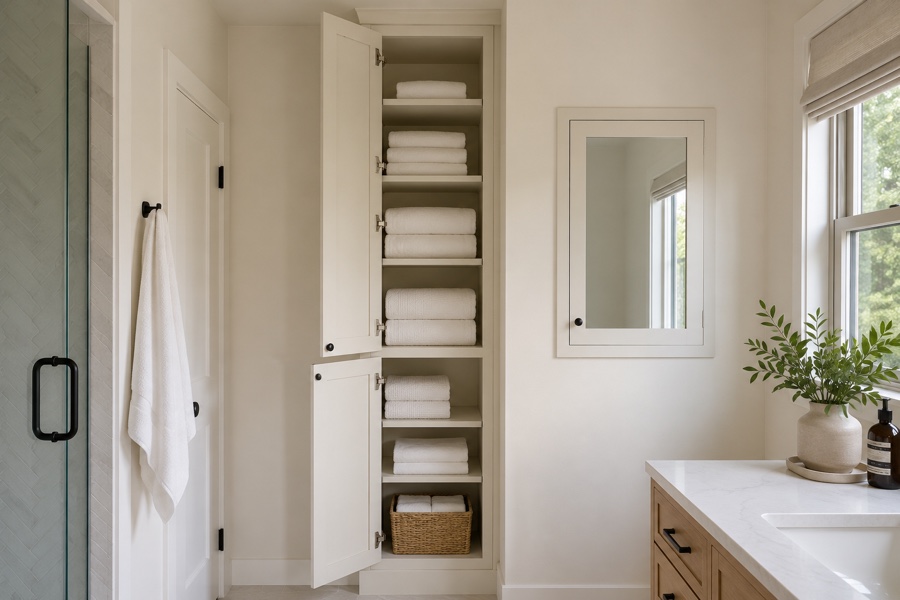
The tall companion piece has caught up too. A linen tower used to be a painted column with doors. Now it wears the same fronts as the vanity, carries a shallow open shelf at eye height, and either floats to match its neighbor or stands on a slim leg frame. Built in one batch, grain and finish agree across both. What these choices cost shows where each lands, and kitchens built in the same run covers the house-wide version.
Frequently Asked Questions
How much weight can a wall-hung floating vanity carry, and what does the wall need?
More than people expect, and the limit is almost never the cabinet but the wall behind it. Standard practice is a ledger or a sheet of plywood let into the stud bay before the drywall closes, with the case bolted through into solid framing rather than drywall anchors. Built that way, a wall-hung piece with a stone top, two basins, and a full load of drawers sits well inside its margin. Without that backing it is a repair waiting to happen. The reinforcement goes in while the wall is open, which is why the floating question gets settled at the measure.
Does floating a vanity sacrifice storage compared with a floor-standing one?
A little, and less than the photographs suggest. You give up the toe-kick zone and a few inches at the bottom, since the case has to clear the floor. What comes back is a drawer bank a hand reaches into cleanly and a floor a mop crosses in one pass. Compare drawer inches rather than cabinet volume: the lower third of a floor-standing unit is mostly awkward space around the plumbing. Where storage outranks the look, the answer is vertical, and a tall companion tower recovers more than the floating case gave up.
Which vanity trends survive resale scrutiny, and which read as fads?
Sort them by whether they are a shape or a decoration. Floating cases, integrated basins, drawers in place of doors, and warm figured wood are shapes and materials, and a buyer reads those as quality rather than a date stamp. They survive. The decorations carry the risk: heavy fluting on every front, a wildly veined stone picked for drama, a bowed drawer bank, and saturated color on the cabinetry itself. None are mistakes if you love them, though they are the parts a buyer mentally repaints.
Planning a vanity for the next ten years?
Free in-home consultation and a written quote. No pressure, no obligation.